Architects of Absurdity: Navigating Gilliam's Beautiful Nightmares


 YouTube YouTube
 Apple Podcasts Apple Podcasts
 Spotify Spotify
 Goodpods Goodpods
 Amazon Music Amazon Music
 iHeartRadio iHeartRadio
 Podchaser Podchaser
 Overcast Overcast
 PocketCasts PocketCasts
 Castro Castro
 Castbox Castbox
 TuneIn TuneIn
 Deezer Deezer
 Spreaker Spreaker
 RadioPublic RadioPublic
 Pandora Pandora
 Podcast Addict Podcast Addict
 Soundcloud Soundcloud
 RSS Feed RSS Feed
In this holiday edition of Look Behind the Look, we unwrap the layers of Terry Gilliam's 1985 film Brazil, a retro futurist fever dream that cleverly disguises its incisive critique of bureaucracy and authoritarianism as a Christmas movie. Join us as we explore the film's rich aesthetics, from its elaborate production design to the campy hair and makeup, revealing how these visuals reflect the emotional machinery of a society struggling under the weight of conformity and denial. Discover how Brazil remains relevant today, echoing our contemporary challenges with digital systems and the normalization of crisis.
0:00 - Intro 1:28 - Gilliam After Python: The Architect of Beautiful Nightmares 3:05 - The Look: A World Styled for Breakdown 4:12 - Camp as Survival & Bureaucratic Beauty 5:25 - Imagination as a Last Resort: Sam Dreams 6:18 - The Restaurant Scene: Elegance at the Edge of Collapse 7:05 - When Help Becomes Theater 7:41 - When Emptiness Becomes Violence 8:27 - The Christmas Setting: Festivity as Emotional Camouflage 9:36 - If Brazil Were Made Today 13:27 - Closing
Get full access to Look Behind The Look at lookbehindthelook.substack.com/subscribe
0:13 Welcome back to Look Behind the Look, where we unwrap the aesthetics that hold entire worlds together, or in today's case, barely keep them from collapsing onto the dinner table. Since this is our holiday edition, we're taking a look at a film drenched in tinsel, bureaucracy, and a very specific brand of existential dread, Terry Gilliam's Brazil, the 1985 retro-futurist fever dream that has aged with the accuracy of a warning label. It's one of the most incisive science fiction films ever, disguised as a Christmas movie. A world of paperwork, plastic surgery, and sagging ornaments held together by denial and duct tape. The film's world building leans heavily on its hair, makeup, and costumes, and production design.
0:58 A system of visual cues that reveal exactly how much rot a society can decorate before the whole thing smells. And underlying all of it is the central truth. Brazil exposes the emotional machinery that allows authoritarian systems to survive, denial, decor, civility, and the relentless performance of normalcy. Through beauty, camp, and Christmas pageantry, Gilliam shows how a society decorates its own oppression in order to endure it. Terry Gilliam carried his Monty Python instincts into his feature work, not just the punchlines, but the distrust of order and the devotion to imaginative rebellion.
1:39 His post-Python films from a constellation of dark fairy tales, Time Bandits, a universe run by cosmic clerks, Munchausen, where fantasy drowns under municipal paperwork, The Fisher King, trading dystopia for personal catastrophe, but with an emotional landscape that's identical. A broken world propped up by fantasy, ritual, and whatever stories people construct to make the unimaginable feel survivable. Fun fact, this is my husband's first film. Keep your eyes peeled. He's one of the teenage bad guys. Twelve Monkeys, a descent into institutional delirium. The Zero Theorem, algorithms humming louder than human desire.
2:20 And then Brazil, the access of his worldview, a dreamer caught in the machinery of a system that mistakes paperwork for purpose. Gilliam's obsessions place him squarely in the dystopian lineage of Kafka, Orwell, and the bureaucratic nightmares of Eastern European absurdism. a tradition where oppression isn't enforced through spectacle, but the slow suffocation of imagination. What Gilliam adds to that canon is an irreverent maximalist visual language. Where Orwell used austerity, Gilliam uses excess. Where Kafka used silence, Gilliam uses noise. Brazil sits at the intersection of those impulses.
3:05 The Look, production designer Norman Garwood, who earned an Academy Award nomination for his work on this film, gives the film a texture you can practically inhale. Peeling walls, industrial ductwork that coils through every domestic space, machinery that sighs harder than the characters. Writer A. Kim once described those ducts as the state of mind visible. But they also function like veins, pulsing, overworked, and entirely uninterested in the comfort of the people living underneath them. Costume designer James Atkinson took great care in designing silhouettes that swallow bodies whole. The shoe hat, leopard prints, and cachet of bizarre ensembles were inspired by Dali and Schiaparelli and sold the surreal, anachronistic styling each character embodied.
3:53 Every lapel droops, every hem sags, every costume conveys chaos and grinding exhaustion, the kind that can't be steamed out. The Christmas decor slouches in the background like a half-hearted apology. A season meant to lift spirits ends up highlighting the weight of everything pressing down. The hair and makeup departments bring a kind of militant camp to the film. Curls lacquered into defiance. Faces contoured with the determination of a woman preparing for battle in a department store bathroom. Aaron Sherman, Sandra Sherman, Maggie Weston, Sandra Shepard, Maymere Jones-Lewis, Sally Evans, and Elaine Carew.
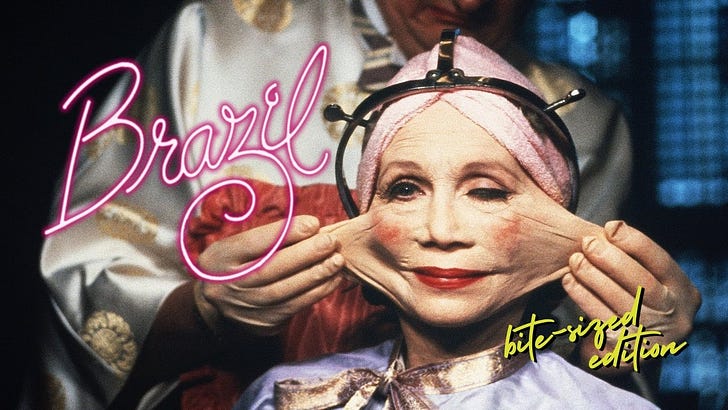
4:34 orchestrated the hair and makeup design with the confidence of seasoned artists at the top of their game who know exactly how much absurdity a dystopia can support. The results are gloriously unhinged, beauty inflated to the point of satire, glamour motivated by a descent into madness, every brushstroke a middle finger to the horrors of bureaucratic life. Ida Lowry's cosmetic treatments are a special category. Suction tubes, tightening skin that wants to flee the face. Chemical pastes promising youth they can't deliver. The Gemsbach called it beauty pushed past the point of reason. A description that lands even harder in an era of filtered perfection.
5:15 Camp becomes a form of resistance here. Delicate, theatrical, and aware of its own futility. Aesthetic bravado in a world that keeps dimming the lights. Running through Brazil are Sam's reoccurring dream sequences, the winged warrior slicing through monolithic structures to reach a woman who keeps dissolving before he can touch her. These visions are the last corners of his mind, not yet suffocated by the enforced normalcy that governs his waking life. They're operatic, excessive, and embarrassingly sincere. Everything the real world refuses to allow. And that's the point. The dreams expose how authoritarianism infiltrates the psyche.
5:55 Even fantasy becomes contested territory. The sky keeps falling with debris. The giants keep returning. The damsel keeps slipping away. Imagination tries to break free, then gets dragged back down by the same machinery that crushes Sam at work. Gilliam isn't sentimental about escape. He shows that even the subconscious is running out of places to hide. The restaurant scene, elegance at the edge of collapse. A pastel dining room, a bomb, shredded walls and bodies, and a table of perfectly coiffed women asking a waiter with quiet urgency to reposition a decorative screen so the carnage won't interrupt their lunch. This moment reveals an entire psychological ecosystem, denial dressed as poise, civility stretched thin over terror.
6:43 A. Kim calls it the normalizing effect of constant threat. But it plays like a joke told by someone who hasn't slept in days. The waiter glides through rubble with the serenity of a man trained to ignore the obvious. Service must continue. The room must appear intact. The illusion holds, if only through muscle memory. When help becomes theater, When central services arrive at the Buttles home to repair a hole in the ceiling, its attempt reads like a community theater production of home maintenance. The parts don't match, the hole widens, the paperwork multiplies. They blame the metric system, sign a few forms, and leave the problem exactly where they found it, humming, leaking, and waiting to burst.
7:27 The CSPO's essay on the film describes this pattern as assistance that optionalizes harm. The kind of bureaucratic charade that many people today recognize instinctively. A system rehearsing competence rather than practicing it. When emptiness becomes violence, the Ministry of Information's interrogation chamber reveals another flavor of denial. The violence of aesthetic emptiness. The room is a blank white void, no decor, no visible machinery, nothing to hold on to. It's clinical to the point of obscenity. A space designed not only to facilitate suffering, but to erase the possibility that suffering is happening at all. This is the state's opposite strategy from the holiday clutter outside.
8:10 Instead of drowning the space in terror, it evacuates the space completely. The brutality becomes abstract, procedural, unmoored from human consequence. The room doesn't just contain the interrogation. It sanitizes the act, giving the violence a bureaucratic respectability. The Christmas setting, festivity as emotional camouflage. Gilliam's choice to set this story during Christmas amplifies everything already cracking underneath the surface. Cinephilia and Beyond once observed that the season insists on joy, even when joy has no foothold. And that insistence becomes an emotional straitjacket. Tinsel droops over broken infrastructure, plastic holly clings to dying machines, and the soundtrack hums with enforced cheer.
8:55 like a smile someone forgot to release. Holiday consumerism is equally destabilizing. Early in the film, a department store bombing sends shoppers scattering between garlands and shattered ornaments, a perfect image of a society determined to maintain its traditions, even as those traditions are reduced to debris. Christmas becomes less a celebration than a demand. Shop, smile, behave. The state doesn't need to enforce compliance when the culture already insists on it. Christmas here functions like a filter applied to a crisis, smoothing nothing, obscuring everything, a ritual demanding warmth from a world that can't produce it.
9:36 If Brazil were made today, what's most unsettling about Brazil is that 40 years later, its warnings still land. But if Gilliam were making the film now, the critique would have to go even further because the world has gone further. In 1985, Gilliam was responding to rising bureaucracy, state incompetence, and the creeping normalization of authoritarianism. In 2025, the architecture of control isn't paperwork and ductwork. It's data, algorithms, aesthetic pressure, and narrative manipulation. A modern Brazil would almost certainly expand its lens to include algorithmic bureaucracy. If a typo in 1985 could destroy a family, imagine what an algorithmic error can do today.
10:21 A contemporary bottle-tottle mix-up wouldn't be a clerical mistake. It would be a data glitch that autofills itself across every database, every platform, every automated system. Oppression would be instantaneous and invisible. Beauty and self-surveillance. The film already mocks cosmetic culture as conformity, but today, beauty has become self-administered authoritarianism. Filters, fillers, facial optimization. People police themselves before institutions even need to. A new Brazil might show people modifying their faces not for beauty, but to pass through biometric recognition systems. The camp aesthetic Gilliam loved would translate seamlessly to the curated perfection of influencer culture.
11:05 Consumerism coma. Gilliam used Christmas as an emotional distraction. Today the distraction is constant, infinite entertainment, endless notifications, doom-scrolling as pacification. A modern restaurant scene might feature diners live-streaming the explosion behind them, editing their reactions, farming for engagement, or otherwise manipulating our consciousness to prevent us from believing what we are seeing." Government branding. In Brazil, the state pretends to help. Today, it would be market that helped. The central service workers would arrive in corporate-sponsored uniforms, filming their repair for a government TikTok account, hashtagging here to serve.
11:47 The duct still wouldn't fit, the ceiling still would leak, all staged for social media, and the video would go viral. Imagination as the final frontier. Sam Lowry's dreams are the last space the state cannot touch. Today, even imagination is under siege via AI-generated content, algorithmically curated fantasy, and the commodification of identity. Faceless bureaucrats wouldn't chase modern Sam. He'd be overwhelmed by infinite content, infinite demands, infinite noise. Escaping into fantasy might not be liberation. It might be another trap. As the LA Times wrote in its 2025 retrospective, Brazil predicted our drift toward a world where truth fractures and spectacle replaces substance.
12:35 A modern version would simply push that fracture even further, showing us a society drowning in distraction, aesthetics, and performance. And that's why Brazil still hits. Because its dystopia isn't about the future. It's about the patterns we still refuse to break. Where Gilliam warned us about paperwork, today the danger is digital. Systems that don't merely misfile you, they erase you with a glitch. And yet, the emotional core remains. We still cling to rituals, normalize crisis, and decorate despair. That's why Brazil endures. Because it understands how people survive the impossible. Through fantasy, through denial, through beauty. through humor and sometimes through dreams that are only spaces left untouched.
13:20 And if a filmmaker tried to warn us today, they'd have to cut even deeper because we've learned to normalize even more. So here we are, watching Brazil during a season built on comfort, A season asking for joy while the world feels unsteady beneath our feet. Our political institutions and the agencies tasked with care now treat citizens and non-citizens alike with a coldness that echoes Gilliam's world in the ways the film never could have predicted. Or maybe it did. Yet people keep pushing holiday cheer uphill, hoping momentum will carry them the rest of the way. Gilliam warned us about paperwork. Today the threat is metadata. And so much more.
14:02 Brazil remind us that denial may buy time, but it never buys peace. So this holiday season, if you're looking for a Christmas film that speaks uncomfortably to the present, revisit Brazil. Because 40 years later, we're waking up to the tinsel burning. How's that for Holly Jolly Christmas?


