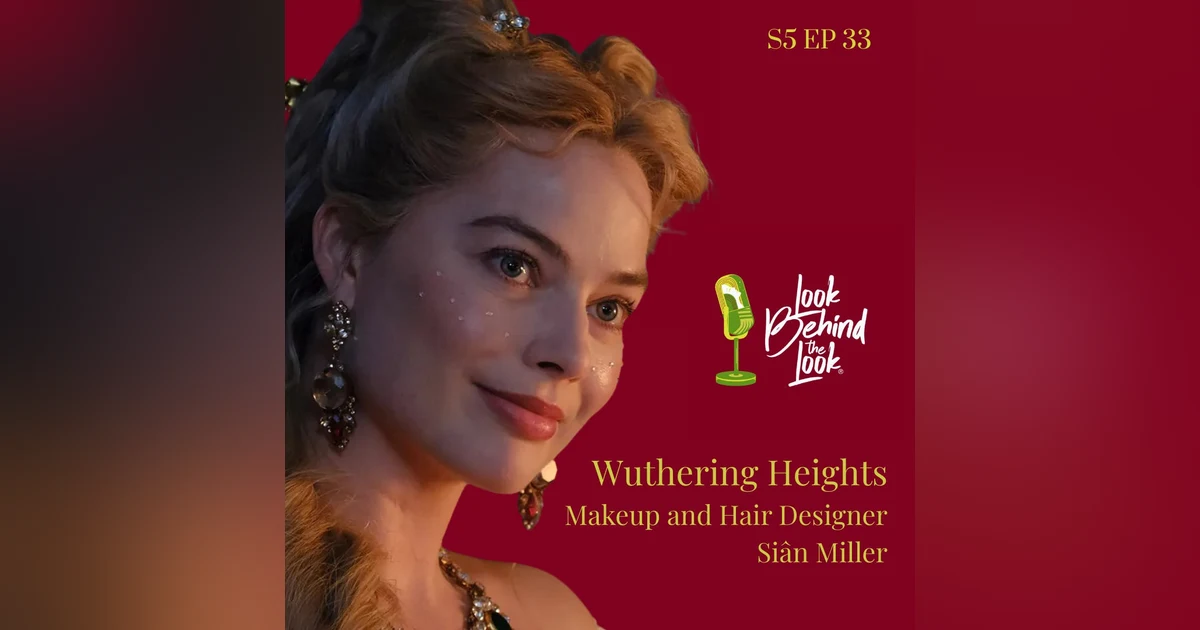
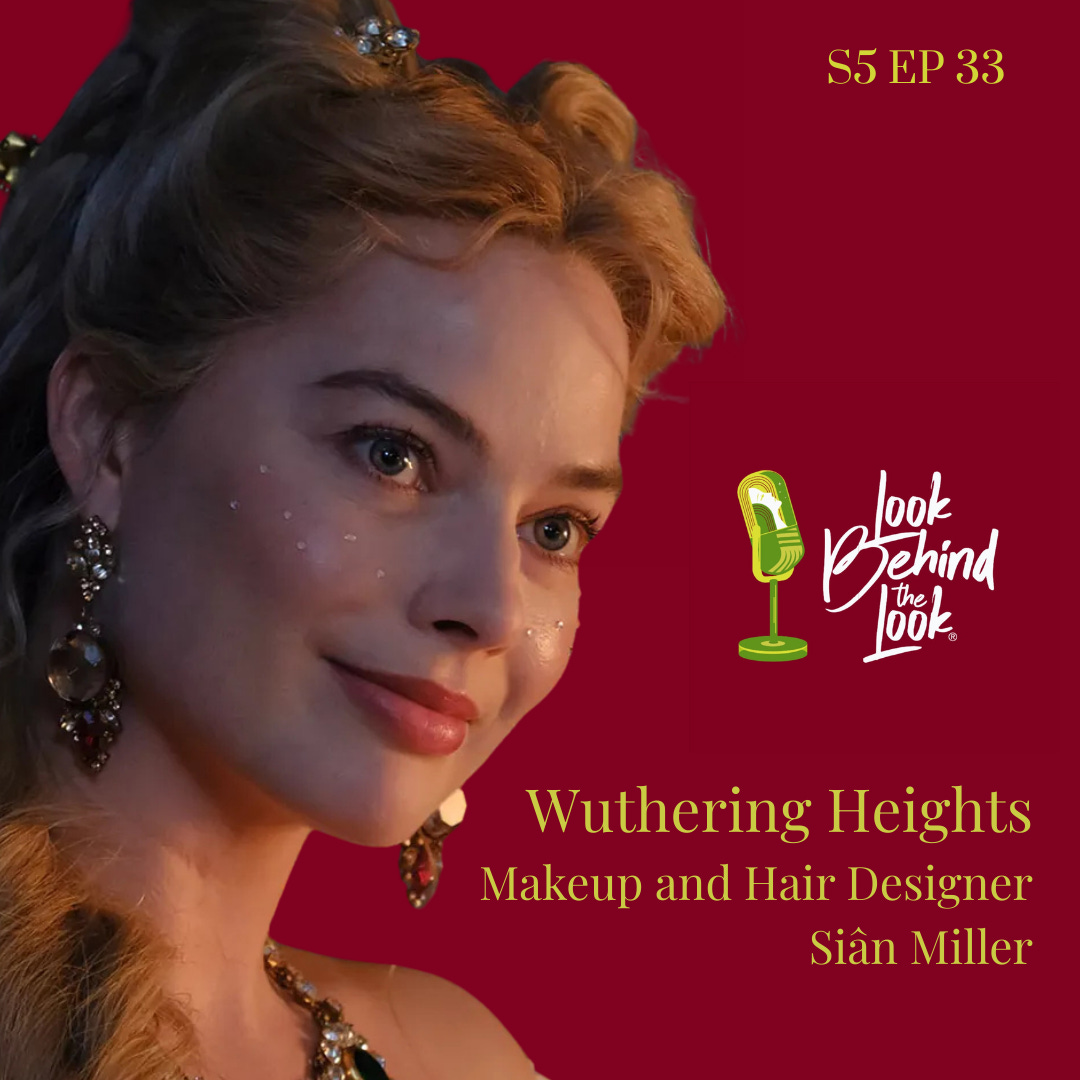
Windburned and Wild: Hair & Makeup as Storytelling in Wuthering Heights with Siân Miller


 YouTube YouTube
 Apple Podcasts Apple Podcasts
 Spotify Spotify
 Goodpods Goodpods
 Amazon Music Amazon Music
 iHeartRadio iHeartRadio
 Podchaser Podchaser
 Overcast Overcast
 PocketCasts PocketCasts
 Castro Castro
 Castbox Castbox
 TuneIn TuneIn
 Deezer Deezer
 Spreaker Spreaker
 RadioPublic RadioPublic
 Pandora Pandora
 Podcast Addict Podcast Addict
 Soundcloud Soundcloud
 RSS Feed RSS Feed
I love any opportunity I can get to speak with Siân Miller, and what luck it was to have her on for "Wuthering Heights" to discuss all things wild... and contained. Braids for days, vacuum masks, intricate hairstyles only to never have film coverage, and yes... sigh... windburned cheeks. I have known Siân since she worked on Cyrano- a beautiful treasure of a film that many people might not know about, and we dug into all things Saltburn last time, but today we will talk about the film that has us all in the beauty world swooning. What did you think of Wuthering Heights? Have you tried any of the looks yourself?
Siân and I also talked about where Hair and Makeup Falls on the priority list of time on shoot days- I’d love to hear from other craft departments about this topic. Makeup and Hair is often disregarded as a chunk of time allotted to vanity, when it is actually vital to the character creation and needs to be reestablished every shoot day. What are your thoughts on this as filmmakers and artists yourselves?
Learn more about the products Siân used on-set here:
0:00 - Intro
4:04 - When to Modernize the Story
6:12 - Working with Emerald Fennel
9:13 - Creating Cathy’s Hair
12:41 - The Thought Behind The Skin Room
14:17 - Matching Cathy to the Dining Room
17:17 - The Making Of Siân’s Favorite Scene
19:56 - Meaning Behind the Freckles
22:27 - Makeup is an Underappreciated Art
28:10 - Working with Jacob Elordi Again
30:26 - Outro
Get full access to Look Behind The Look at lookbehindthelook.substack.com/subscribe
0:07 Welcome to Look Behind the Look, the celebrated podcast that explores your favorite looks in film, television, and fashion history. Through conversations with the fashion world's elite and award-winning hair, makeup, and costume designers on sets around the world, you will see and hear exciting tales from behind the scenes, career origin stories, and tons of advice and tips. I'm your host, Tiffany Bartok. Hey, everybody, welcome to Look Behind the Look. This is the Wuthering Heights episode, and my guest today is frequent visitor Shawn Miller, who I like to call friend. She is an amazing artist, the hair and makeup designer behind Wuthering Heights. I've had her on several times before, and I always love talking to her about the filmmaking process and the storytelling through hair and makeup design.
0:53 There's lots of Easter eggs that you may or may not know in the hair and makeup design of Wuthering Heights. You've definitely seen the film by now, so I want to hear what you thought of the film. If you're waiting for it to come on streaming for some reason, tell me what you think of it after you've seen it in the comfort of your own home. Hopefully not while distracted by another screen. Enjoy this episode with Sean and I and see you next time. Hi, I'm with Sean Miller and I am so excited to talk to you finally about Wuthering Heights. I've been singing Kate Bush all morning in anticipation and I'm sure you want to like just...
1:34 Either that's your theme song for the rest of your life or you want to get rid of the record and never hear it again. Yeah, it's funny. I'm a big Kate Bush fan and I did get to see her twice in 2014. No, you're so lucky. Yeah, I was largely too young in 79. But yeah, it's a bit like Murder on the Dance Floor. They get to the point where you're like, okay. And I'm probably Kate Bush's biggest fan, but I don't want to hear that again for a while. I know, I know. Thank God it's such a beautiful cover. Yes, I can't wait to talk to you about all things Weathering Heights. You've been talking about it so much. And everybody is just, I mean, one thing everyone can agree on is that it is beautiful.
2:17 It's a very polarizing film. I personally loved it. I, you know, I love that she puts Weathering Heights in quotes so that it's, you know, this Baz Luhrmann type of vibe of like, what makes it, what makes it current and still honors the period. So that's definitely what I wanted to talk to you about. If that was something you guys were dealing with, if you want, how much you wanted to honor the time period and how much and when you decided to sort of modernize it. Yeah. Yes, a really interesting starting point.
2:57 It started, of course, with Emerald's script because, you know, I knew from Salkburn, you know, they're so full of detail. Yeah. So incredibly detailed script. And then not only that, her mood boards. Her mood boards are incredible. So that's the first thing I got sent. I got sent the script and the mood board at the same time. So already in my mind's eye, it's incredibly evocative of the world in which Emerald was taking us into. Mm-hmm. You know, and she draws from the same kind of sources of inspiration, whether it's film, photography, the world at large, nature, architecture, food, grass-stained knees on children, just a plethora.
3:38 There was a brutalist architecture in this and bent over trees. There was great stills from old movies. I mean, there was just so much in there. Runway, so many fine art, historical, some historical references. I mean, all sorts of things. And so really, I knew that one of the first things she said to me is imagine that this is through the eyes of a 14 year old, just as she was when she did. I felt 14 for sure. For sure. Watching it. So she said that at the beginning. Beautiful. And that it's a kind of fever dream. Everything that's been said. And imagine it as a kind of fairy tale. So with that in mind, I kind of then went away and on one of those secure Pinterest boards, I amassed a ton of photographs and nothing felt wrong.
4:22 Didn't necessarily feel right. Just like let's just pour in things that we think that might suit this world. And then I found it was it was really about learning the language again. I mean, I'm lucky because I have a shorthand with Emerald. I've worked with her before, so I kind of do understand that. Tell me what you understand about her starting point, you know, that shorthand. Because there were so many, the collaboration between this and Saltburn, I mean, if I'm to watch the two of them back to back, I recognize you right away and I recognize, of course, Emerald right away. So what is that starting point? In her office, the walls were covered in the mood board plus.
5:02 It was the mood board maxed out. Every single wall was covered. One wall, you had a ton of costumes. And Jacqueline Durran, you know, pivotal in my whole process, needless to say, and is so supremely brilliant at what she does, as is Susie Davies. So with Jacqueline, Susie and Emerald in my first roundtable meeting in this room with a large desk covered in imagery and the walls, I mean, a wallpaper surrounding us of just images of the Nicola Turner sculptures that are oozing out of the windows and following heights. Rocks with kind of cracks in. The brutalist architecture. Stills from the Night Porter.
5:43 Mm-hmm. stills from, of course, you know, Terrence Stamp, not because I want Heathcliff to look like Terrence Stamp with the black hair and what have you, but mood. A lot of it was very much the real truth of the term of a mood board. It was about the mood. And so being able to see that across the walls and just look at that kind of chronology and the grime and the decay of everything that Wuthering Heights became and also how Spartan Wuthering Heights is. It's incredibly Spartan. It's incredibly minimal. Right, right. That's very interesting, yeah, because it does seem so maximalist, and then when it's all taken away and stripped, it's still beautiful.
6:28 Well, Wuthering Heights, the house, is incredibly... That section of the movie, it's basic, it's the farm, it's the yard, but if you look at... You know, the fantastic parlor with the drawing or whatever the room is called, with the double height ceiling and the black and white checkered floor. It's very minimal furniture in there. It's a couple of checks. It's very Spartan. um the fantastic low ceiling that um Susie Davis had created with Jacob can barely stand up in you know again the big table yes so we knew that that side of the world would be that just that and quite minimal and kind of nothing would be overdone very raw very exposed um the materials felt very raw and very organic And then in contrast to that, the Grange, which, of course, is so it's just I mean, it's that quintessential kind of doll's house.
7:23 And then, of course, there is the doll's house in that fantastic silver panel dining room. So I knew that what we were doing would be I had I had a really strong idea because of what Susie was doing already, what Emerald was doing of where we were going. So it really fed into my understanding of the hair that it wasn't a case of going to the 40s or going to the 50s or going to 1840 or 1780. It was a case of... In terms of Cathy, what suited Margot? It was a case of what can we do that fits into this, that alludes to and actually satisfies every single note in the script about hair, of which there were so many.
8:08 Oh, really? Oh, my God. So I really realised when I read the script that it's such a huge, important part of the narrative, particularly with Cathy's character. Yeah. And actually arguably with Nellie as well because she's so done up and everything is. She knows her place and everything is just so. She's never let go until the end when you see that she's trying to come undone. So in contrast to that with Cathy, I knew that as much as there was a wild abandon when we first see her hair and she's running and it's flowing free and textured and it's wild and windy on the moors, But then that would sort of translate to when she grows up in the Grange and in Wuthering Heights.
8:49 And then, of course, when she moves into the Grange and she becomes Isabella's doll. And then it's dress up and the doll braid and the doll. And it just is just sort of it's a cherry on the cake. So we're am I correct in thinking that we're to understand that Isabella does her hair, does the corset. OK, so and and now I can ask you because you're here. Is it a corset or is a vagina? Oh, that's not the vagina braid. No, that's the corset, the doll braid or the corset braid. The vagina braid, which people are talking about a lot now. Yes, yes, yes. Is in the scene where Kathy pulls Isabella's hair.
9:30 Okay. Okay. Okay. Okay. She's talking to Heathcliff and she says, you're listening, aren't you? And she comes in and she's a total bitch to her. And that's when she's wearing that in the back of what is a very elegant, beautiful hairstyle. Yes. A bit of Chanel jewelry in the back hanging from the red ribbon, if I remember rightly. Oh, the details. Yeah. Yeah. And that's what that is. But yeah, the idea being that when Kathy goes to the Grange and she's now married, That whole scene where Isabella takes her through what was her ribbon room and is now Cathy's dressing room. And I've had all these costumes made to your measurements. And look at the walls. They're your skin. And that's your freckle. And there's a hair growing from it and all of this stuff.
10:12 And then we get through and she's dressed up and she has the corset, the doll braid on, beautiful dress. And then, of course, we go into the dining room. And it's already there. It's already been made by Isabella. I mean, everything was planned. Nothing. None of this is by accident. So, yes, that's that's the whole connotation there that she has created that is preordained. Wow. And your hair is so singular. Yeah. Yeah. You know, and I and I took the hair from your hairbrush. The way it was played is so creepy, you know, but she made it so innocent in the delivery that, I mean, I saw it with the full house. Everyone was laughing.
10:53 Like, you know what I mean? But like, maybe if I was alone, I would be like, this is so damn creepy. Well, it is funny, but it's creepy. I mean, Alison is so brilliant in the film, but it is. So brilliant. Yeah. Wow. So. So when they decided to make the skin room, like what comes first, the skin, her skin or the skin room? Like, how was this developed? I think Susie already I'd read something where I think she had this fabric. OK, OK. It could do something. You know, I don't want to misquote her, but I'm pretty sure that how that came about. And I was asked if I could get hold of a photograph. And then I think they sourced more because this is what we want to do in here.
11:35 We've got this amazing fabric and this is what we're going to do. And Susie is a good friend of mine. You know, she took me around the sets fairly early on. Oh, that's amazing. And she said, look what we're going to do in here. And it's going to be skin. And I was there was just a panel. And it was like the best collagen bouncy skin that a girl could ever wear for. And it sort of bounced back. And I mean, it was just incredible with the veins running through and the carpet. The carpet's the vein. It's incredible. And then the hair. So I then gave them pieces of Cathy's wigs. just a hair colour sample, because that's then dressed in at the back of the bed. Right, right. Yes. And around the pedestal of the tables in that bedroom is hanging down.
12:18 I mean, it's incredible. So, yeah. It sounds like the rooms are being developed first. And it's like my favourite room. I don't know what you are calling it, but it is the one, the sparkly blue room. We got to see it in daytime and nighttime. It looks like... The dining room. Well, no, they're not eating in it. Oh, is it the drawing room? They're sitting in it. Yes, yes, yes. And then to have her face match the walls. Christmas and the, yeah, yeah. Oh, the face matching the walls with the beads on. Yes, yes. Tell me about that. Okay. Yes, yes.
12:59 That all started with the production design because the room is, it's enormous. Okay. Cool. So it's enormous with this really big long table. And I've seen that this has been discussed by Emerald, that, you know, it was designed very much the idea that they would feel kind of like doll-like in that space. And then, of course, there is the doll's house at the bottom. And when I first started talking to Susie Davis and Charlotte Dirick's set deck, And we were talking about the montage and really how we would all the departments would manage the montage. My God, what a Herculean effort. Herculean. And it wasn't just my department. It was every single department costume, you know, set deck.
13:40 It's like how production design, how do we manage this enormous amount of work in what's going to be probably quite a very short amount of time? And so there was a lot of planning and a lot of not quite knowing where we'd be going. And, you know, there was some tests on stand-ins and then Nana Fisher got to, with very much, you know, with Emma and myself, got to then spend some time Nana trying various things out on Margot. So we kind of knew that we had motifs that worked. Emerald had come up with the tinfoil star, you know. Yeah, it was just, okay. And so one of the early things in terms of the silver room were the Regency kind of beads adorned on the silver panels in them.
14:23 Yeah. Or to the floor. And so it was suggested that, ah, it might be quite nice to actually see this on her face in this scene, because we're doing this to kind of show kind of like perspiration. Yeah. Like the walls are sort of sweating. So it'd be really nice to translate that. So that's where that started from. And originally in the first test on a stand-in, they were silver. But then Emerald was like, you know what, I like them clear. But then the actual scene that they appeared in, you know, it wasn't a montage. It was actually a scene and suddenly it was all about us being equipped and having everything on set. And so we'd go to set with hair pieces and beads and set up a room that we could kind of cater for all these things.
15:06 And then at the last minute, Emerald was like, you know, I think that's a great idea. And Nana was able to fish them out and put them on. And they kind of mimicked the past and of the freckles. And that was that. So it was all very organic. And, you know, as it always is with Emerald, it's very much led by her. It's very much, you know, a great collaboration across all departments. And so that's where I took the cue from, from the art department. Right, right. I mean, it's so harmonious and just every, it's stunning. That montage, I mean, it reminded me of one of those 90s music videos where you just wanted to like freeze frame and like recreate each individual. Which one was your favorite?
15:46 Oh, goodness me. I do love the rose tinted glasses. I love that bit where they're sitting up at the back of the garden. Oh, yes. I mean, how we did that, we had about an hour, about an hour, an hour and a half at the end of one day and costume and Jacqueline Durham, myself, we laid out trestle tables and put our wares like we were at the market. This is what we've got for sale. So we had all the bits. And then you had the art department and it was almost like being on a kind of a lazy Susan. And as the camera was going that way, people were kind of running around changing, you know, and so there was a massive redress. And then and so it would be it was a case of it was so exciting.
16:26 Everybody loved it. It's like a kind of a game show. We're all kind of challenging each other with a kind of a bake off style. Right. What are you going to do now? A cooking show. Yeah, it was like a cooking show. And it was, you know, with the pace of that and the egg time accounting down for everybody. So hats, you know, hats, bows, ribbons, lip size and the hair pieces. I just decided from the get go, which I think caused a bit of confusion with my team initially, that whatever we did, it had to be like Lego. Okay. And so, you know, Lego creator, one minute it's a plane, the next minute it's a car. So we'd have lots of pieces. I love that. That's great. Yeah. And what do you mean by it causing confusion?
17:07 Because people couldn't remember how the Legos. Well, yeah, because I was like, well, I'm a big Lego fan. We need to make these bits like Lego. They just need to be able to switch in and switch out and change something around. But quickly, because when Emerald and I discussed these montages, what the fundamental part of my brief was, whatever it is, Sian, it's got to be quick. Of course. So we knew these pieces. And yeah, I loved it. But I think, yeah, my favourite bit is probably the bit when they sat up at the back and Margot has the little glasses on. It's a kind of a sort of a braid with a braid sewn over the top. But there are crawfish there.
17:48 Crayfish? Crawfish. With top hats and sunglasses. Oh, yes. Yes, yes, yes, yes. Tom Chao was talking about that the other day. That was very Bosley. Yeah, yeah, yeah, yeah. It was incredible. And the goldfish in the urn, the real goldfish. I had to breathe, so we had to have a goldfish wrangler. And it was just so exciting. Oh! to be able to do that and then to see it in the film with the song over the top and it was just so exciting it brought back great memories yeah oh my god and and tell me about the freckle mask and the development of of that yeah so I think the ethos behind um the the style of You know, rather than talking about all the specifics of what blush here and what blush there, the whole, the crux of it was that we wanted Cathy from childhood to have that weather-beaten look, you know.
18:43 Yes. They live in isolation. That's where she's running wild and free. And so we wanted her to have freckles and to have that kind of flush. and then that to translate to the older Cathy. And I spoke to Waldo Mason, who I work with a lot from Waldo Mason Effects, and I said, look, you know, can you make me something here that I could kind of, I don't know, is it a vacuum form, something that maybe we could do this quickly? I think I'd done something once and I'd seen a little sort of silicon version of something that it was a reshoot on something and it was to draw the freckles into. Right, right, right. when I picked up the reshoots on another film.
19:25 And I thought, well, actually, surely we could just do this kind of like bigger. But actually he said, no, what I'll do is I won't make it soft. I'll make it rigid. I'll make it for you vacuum form. And by vacuum form, you mean that it will. It's kind of like this sort of stiff plastic kind of. So we've scanned both of the actors. OK, three scan them. So it was them to be able to produce a 3D print. And then the vacuum form is literally the sort of like a hard plasticized kind of material, like a kind of rigid plastic clear box, I guess, that you could then hot knife through. So then with the freckles being drawn on the skin, I was able to translate and map that onto the mask. And then I because I knew it had to be something we wanted it to, again, speed.
20:09 Yeah. How can we achieve this with consistency and speed? It's a big part of your job is how fast can you do it? It's a massive part of the job. And I think. you know it's great to be able to go into things thinking you know you you can showboat and you've got an infinite amount of time but of course the reality is we all know is that a big part of a job as a designer is yeah we'll come up with some really interesting ideas and we'll do the best we can for you but another part of my brief is i've got to do it quickly yeah so you know there isn't an infinite amount of time a filming day costs a lot of money and the last thing they want to be is waiting for us and And at the same time, also want to avoid having actors in the chair for hours and hours and hours.
20:50 So it's always a big kind of consideration. Yeah, I wanted to talk to you about that because I want to talk to you about... The whole problem with the industry of fighting for the time and thinking that each department, like, we're dealing with in the makeup department, we're dealing with people thinking that it's vanity, you know, unless we're creating a monster, right? And so, like... I'm working on something right now where we have to change the actress into a Hollywood icon. And it takes a minute.
21:30 And, you know, and everybody is standing... When they have that idle time, they're judging, you know, your department. And why is it taking so long? Is it just because Margot wants to look great? You know what I mean? And it's like, no! How do you deal with that convincing... What if a director does not value that? I know Emeril does, thank God. But like, how do you deal with if that isn't respected or understood? How do you communicate it? I mean, I've been very, very lucky, genuinely over the years to work with directors that have appreciated it. The craft overall. But I think there's still because our work isn't prefabricated in the same way that costumes generally are.
22:15 Yeah. You know, there is that organic sense that we are recreating what we've done, you know, day in and day out. And of course, things tend to speed up when it's repetitive and you've done something many times. But, of course, the finesse of it, you know, it can't be rushed per se. You know, you have to hone your skills and try and be methodical and not distracted and do it as quickly as possible. I think it's always a consideration. I definitely I come from a kind of the old tradition of, you know, particularly working in the system in British television in the 90s where it was all hands on deck. So I think to try and kind of bypass any of these problems, if there's a way of doing this, and we definitely did this with creating Cathy.
23:01 It was all hands on deck. There were many of us. There were three of us working on it at the time. Nana was able to do her makeup whilst we took care of the wigs and the wig application and the hair prep. You know, we very much worked it that way. And say, you know, for the death scene, you know, it might have been Nana doing head and shoulders and Cheryl and I doing the sepsis on the legs. You know, it was it was very much a kind of and what was fantastic is when you work with somebody like Margot or you working with Jacob or Alison, any of these people, Hong and Shahzad, Martin Clunes. They were at times we were all there were more than one of us. I think that's a way, a really great approach. I think, you know, whatever you can do to kind of come up with the goods and bring it to and get them on set happily.
23:48 So and to try and to try and motivate the team to kind of like, come on, let's just we've got to we've got to do this quickly. You know, I remember on Soulburn, there was a time where we had the sun up, you know, it's the sunrise or the sunset. And of course, there's no waiting for that. And so what we did was we just politely, you know, as much as the sort of ice bath facials were a little penchant of a couple of members of the cast, shall we say, um there was that morning i just politely said to the team knowing that it was going to be right we've really got to step on this 7 15 they've got to be on set not just stepping out of the trailer and that was the day we ran out of ice because you know we don't want to call them too early you know maybe we finished at whatever time the night before um it's like right today we're just going to be economical with the frills because we can still do the job brilliantly but um some days you know and if the sun is not waiting for anybody um And there's a lot of money riding on the sunset or the sunrise.
24:48 So, yeah, it's not always even easy and sometimes it's frustrating. I mean, fortunately, on this film, it didn't happen. You know, we were very we're very lucky. Emerald is a huge appreciator, I think, of the craft. But it is. It is something I think it's especially when it's non-prosthetic and we are often contriving the uncontrived and it's not painfully obvious to the eye. That's right. And I think there's a lot of misunderstanding about what we do. Yes, the nuance. And, you know, I love the nuance work. A lot of the work I've done over the years has had that kind of vein in its approach. And it's it's it's not glaringly obvious. And when I teach, you know, I always do a little straw poll of who wants to go into prosthetics, who wants to do this, who wants to do that.
25:34 And there's a lot of hands raised and there's, you know, the SFX, it's like all the black eye. I said, yes, that's the stuff you're always going to be able to applaud it for. But actually what you've done in terms of making a character, which is seemingly nothing, but actually it's everything. But it's just not obvious if you've done it well. If you've done it well. Much art and creativity in that as the glaringly obvious. And I think that speaks for lots of areas of design. Yeah. I can't emphasize it enough. I mean, especially with Margot looking like she has no damn makeup on, it's just must be such a killer for you because it's like, Oh, you did that. Oh, you know, yes. And that took a long time.
26:14 I was talking about that. Nana did a great job with her makeup. She really did. And again with Isabella, you know, with Cheryl and Hong, I mean, they all had, they all had makeup on, but yeah, the boys, but it's yeah. To do it where it's flawless and it's, On the IMAX. Yeah. I saw it in IMAX. Yeah. It was flawless. Flawless. Now, was this, did Jacob come to you after Frankenstein or before or during, or when was this in? He came to me after Frankenstein. Okay. Yes. And I was able to, I was given access to Jacob and Alison quite early and I, you know, having had the privilege of working with them before, it was great.
26:54 So I was able to get the wig maker, Samuel James wigs to them. pretty early on okay and uh and so good to be working with them both again um and um and yeah and lovely because I looked after Jacob and I'd cut his hair anyway on sort of and even I'd looked after Barry so um it was just great to great to have the opportunity to work with him again and He's so into films, you know, and I'm really into films. So, you know, it's always it's just lovely when you're you get to work with an actor who's so passionate about the craft and so cares about what you're doing. You know, and there was a lot of detail that went into what I did with him just to help him, you know, in Wuthering Heights, you know, the dirt and I rubbed blood into his hair.
27:38 You can't see it, but it's this blood all over his arms, you know, in every single day that he shot the Wuthering Heights scenes because he felt that, you know, he's slaughtering animals there with Joseph in the yard. And it was part of his whole kind of story. I did notice that detail and I wondered too because he speaks a lot about how he uses the makeup so much to get into the makeup time to get into character and I think yeah yeah he really understands what you guys are doing and I and I you know I love the fact that we you know we know each other now pretty well and you know he might put his earphones in and zone out and sometimes it might be a bit of chat sometimes not I actually love it if there if there isn't chat I'm happy either way chicken or beef you know could go either way but it's um but you know it's the process for an actor is so important and that chair time is such a an invaluable precious precious time for them and then it should be a really comfortable zone um so yeah it was it was fabulous working with him again and i'm so happy for him he's doing so brilliantly I know.
28:41 It's amazing. Well, you know, your haircut had a very big part to that launch. I mean, that angle that it comes, I can see it like it was the first time I'm seeing it. Well, Sean, I know you have a lot of interviews and a lot of people to talk about. So I think that I will let you think about what you're going to talk about in your next interview. And I'm so happy to hear all of these. Thank you. secrets and details and to see you shine I'm so so proud to know you and call you friend and I'm just really really excited for your journey with this the pleasure is all mine great to talk to you next time yes I can't wait I can't wait thanks so much bye bye Look Behind the Look is a Vinyl Foot production written by me, your host, Tiffany Bartok.
29:30 Produced by Jace Bartok. Edited by Victoria Pastorelli. If you're interested in learning more, find our video version on the YouTube channel, Look Behind the Look Podcast. There you can see rare photos and clips from our guests. And please follow us on Twitter at Look Behind Pod and Instagram at Look Behind the Look. If you like the show, please rate, review, and subscribe. And tell your friends and spread the word. You can subscribe to us on iTunes or any podcatcher of your choice. Thanks for listening to Look Behind the Look.


