Built for the Academy: Mike Fontaine's Oscar-Nominated Prosthetics of Sinners


 YouTube YouTube
 Apple Podcasts Apple Podcasts
 Spotify Spotify
 Goodpods Goodpods
 Amazon Music Amazon Music
 iHeartRadio iHeartRadio
 Podchaser Podchaser
 Overcast Overcast
 PocketCasts PocketCasts
 Castro Castro
 Castbox Castbox
 TuneIn TuneIn
 Deezer Deezer
 Spreaker Spreaker
 RadioPublic RadioPublic
 Pandora Pandora
 Podcast Addict Podcast Addict
 Soundcloud Soundcloud
 RSS Feed RSS Feed
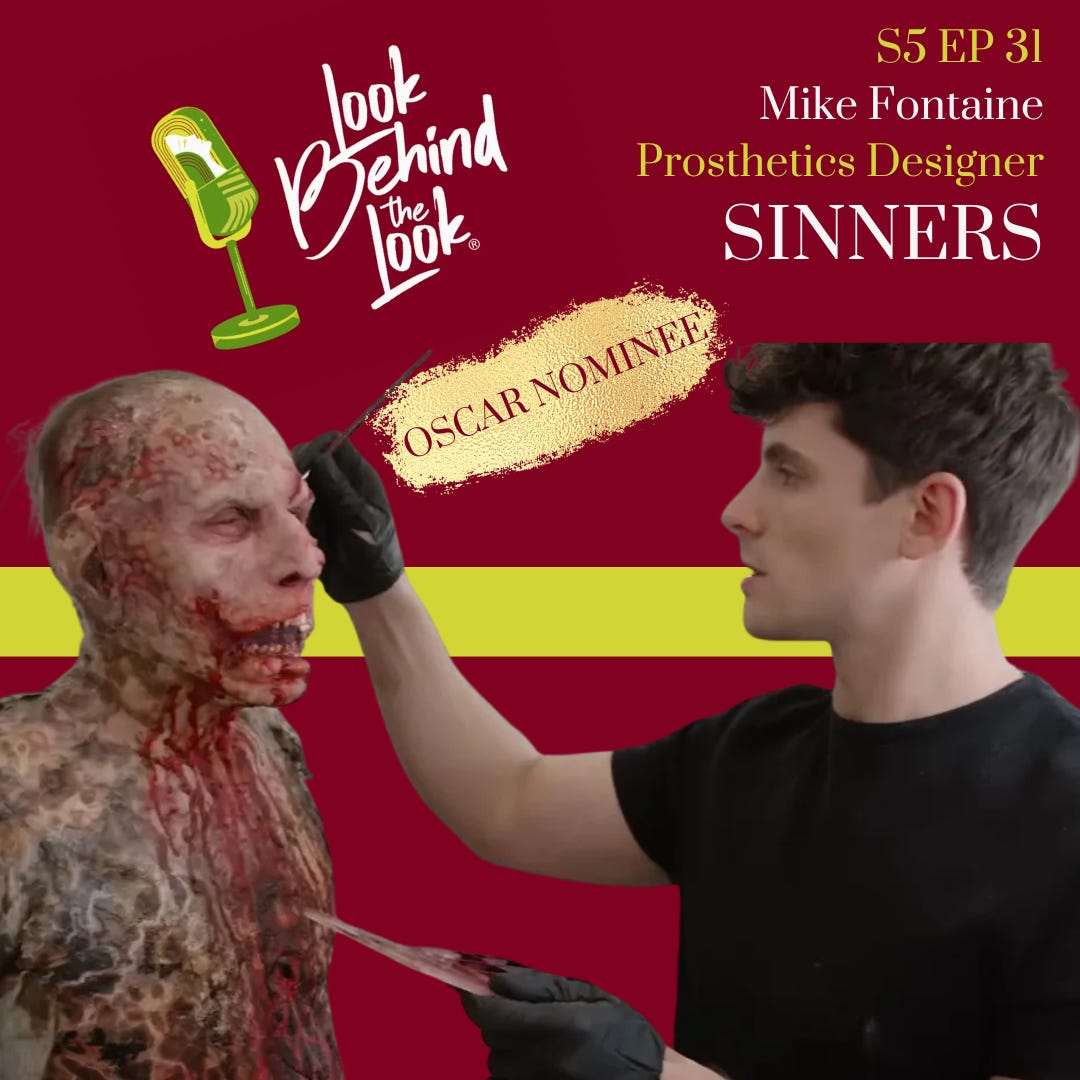
Currently, Mike Fontaine is Oscar Nominated for his work in SINNERS, and his work in Marty Supreme is BAFTA Nominated. I loved hearing Mike talking about knowing what he wanted before he hit double digits and how he became a protégé of Dick Smith—the legendary makeup artist behind The Exorcist and The Godfather—who mentored him into adulthood. Mike shares his experiences collaborating with director Ryan Coogler and the challenges of creating authentic characters. Tune in for a behind-the-scenes look at the artistry and passion that goes into making unforgettable cinematic moments and learn about Mike's deep appreciation of nature and how it is reflected in his work.
0:00 - Intro
2:28 - Mike’s Origins in Makeup
8:11 - Visualizing Sinners from Script to Screen
10:06 - Reality of Creating Looks on a Budget
12:09 - Authenticity and Realism in Creation
17:03 - The Mountain of Work
18:30 - Collaboration Is King
22:40 - Magic with Releases
24:25 - Mike’s Work on Marty Supreme
30:55 - Outro
Get full access to Look Behind The Look at lookbehindthelook.substack.com/subscribe
0:07 Welcome to Look Behind the Look, the celebrated podcast that explores your favorite looks in film, television, and fashion history. Through conversations with the fashion world's elite and award-winning hair, makeup, and costume designers on sets around the world, you will see and hear exciting tales from behind the scenes, career origin stories, and tons of advice and tips. I'm your host, Tiffany Bartok. Hey, everybody. Welcome to Look Behind the Look. Sinners has broken records for its Oscar nominations, and it's nominated for every award they're giving out, basically. I am talking today with Mike Fontaine. Mike is, of course, nominated for the makeup work in Sinners, and he also was nominated for a BAFTA for his work in Marty Supreme.
0:55 We talk about both films We really concentrated on sinners because I just loved talking to Mike about how he incorporated nature into storytelling and really made these zombies, which are not real, guys, they're not real, how he made them seem so real and authentic. And I loved hearing what he had to say. Do not let this man's baby face fool you. He is way beyond his years. His work, his resume is jaw-dropping and so long and rich with amazing projects. And I cannot wait to see how his career goes even further in the coming years. I can't imagine what he is capable of doing. I mean, I can imagine it, so I can't wait to watch it.
1:37 I love hearing about how he really started knowing what exactly he wanted to do as early as age of nine. And his origin story is pretty cool. So enjoy this episode and have fun. Hey, I'm here with Mike Fontaine, who is so handsome and also makes the craziest monsters. I mean, the combo is just too much. You are the talk of the town right now because Sinners has been nominated for an Oscar for your work and many other Oscar nominations as well. And we're also going to touch on Marty Supreme. So tell me about this trajectory of your career, like, first of all, because I know a lot of people have talked to you about the actual work in Sinners, which is extraordinary and well-deserved of the nomination.
2:26 But I also just wanted to get a little bit into your career and how you got this far so fast. And can you tell me a little bit about your origin and how you dove right into everything? Yeah. Wow. Yeah. Well, thank you so much. Yeah. You know, I was very, very lucky because I, you know, I grew up with a dad that loved movies and he was always collecting films and showing me stuff. So I think I saw Michael Jackson's thriller when I was like four years old, something like that. Game changer, game changer. Yeah. So I'm watching, you know, Rick Baker do all this amazing stuff and thriller. And I kind of became obsessed with Dick Smith around the time I was like six years old and just was collecting all of his, you know, magazine articles and begging my parents to let me see the movies that he worked on.
3:20 Oh, wow. I grew up in Massachusetts without any real connection to the film industry at all. And when I was nine, I coincidentally met somebody who knew Dick Smith personally and he just gave me his phone number. So... You know, Dick Smith was my hero, you know, Exorcist and The Godfather, you know, all these incredible movies, you know, for sure the greatest, you know, prosthetic makeup artist of all time. Absolutely. And so I just called him up when I was nine, you know, with my hands shaking because I'd never, you know, talked to him. When you were nine? Yeah. Yeah. I love that. And, you know, anyone who knows Dick Smith knows that he's just the most generous person.
4:03 And he mentored so many people in our industry, you know, from Guillermo del Toro to, you know, Rick Baker. So, you know, he really kind of like took me under his wing and mentored me and, you know, into my teenage years and encouraged me and critiqued me and, you um you know I was I was really really fortunate he kind of uh you know really really gave me the encouragement to go for it wow you know and introduced me to a lot of the artists you know that were working at that time and so I really came into this having amazing mentors was very very lucky so tell me about that though that nine-year-old phone call like do you remember it at all or did you just black out yeah Probably blacked out to, it was kind of brief.
4:52 He said, he was like, well, how old are you? And he was like, why don't you send me some photos of something you've done in the mail? So I actually like took- In the mail. Photos, yeah, that I shot on a film camera and put them in an envelope and mailed them off. And he called my dad back actually. And he said, I would like to help your son and encourage him. Wow. You know, I started doing community theater and plays because that's all I could really think of, you know, to do makeup in my area. And, you know, I would have all these problems and things, you know, trying to figure things out. And I would call Dick Smith, you know, backstage and be like, you know, the nose isn't sticking, it's falling off.
5:34 And he would. kind of give me advice on what to do and and uh yeah it was amazing oh my gosh so then as you grew did you study did you study you you were hands-on you were volunteering and and really teaching yourself well through this mentorship yeah and then did you go to college for art You know, I had just been so obsessed with doing this and I knew I wanted to do this. And, you know, I just couldn't wait to grow up and be out of school. And I built, you know, a workshop in my bedroom. So I turned my bedroom basically into a studio and put benches, you know, all around.
6:19 I took over my parents' garage with foam latex ovens. I, you know, the basement was mold storage and, you know, I had the most supportive parents. They just let me, you know, nearly ruin their house. And I remember going to my mom and saying like, I think I, if we took the bed out of my room, you know, I could build another bench. And she was like, that's it. We're going too far now. Like you're not, you're keeping your bed. You know, I was probably like 14 or something. Yeah, I feel like you could have put a bunk on the top and slept there on top of your workbench, right? Yeah, right? Oh my gosh. No, they're amazing. So right when I graduated high school, I just drove to New York and really never turned around.
7:01 They were like, I think you're good. Yeah, we're confident that you're going to make it. That's great. And then did you start working on films or did you theater or how did you... go into the career once you got to New York. Right around that time, Rick Baker was doing Men in Black 3. Okay. And, you know, I wasn't in the union, so I really, I wanted to work on it so bad, but I couldn't. So they actually let me just go and kind of hang out and just be there. You're not working. I'll never forget one day, Rick's supervisor, Bill Sturgeon said, you know, I have a job for you tomorrow. You're going to carry boxes.
7:41 And I was like, I'm going to carry these boxes really well. So I just tried my best. And by the end of the job, I was able to get into the union. And then I was just working nonstop on films in New York. And traveling all over the world and, you know, really just focusing and trying so hard to get as good as I possibly could and to learn. Wow. Okay. So you got into the films and then, okay, let's fast forward now to all of, I mean, obviously anybody can look at IMDb. Your work is astonishing and amazing. And we, let's get to Sinners because I want to talk about the day that you got that script.
8:25 And like I've read and heard, you've talked about it so much. This movie is absolutely otherworldly. It's so special and so specific. And what did you respond to about it? Because I've heard that you and Ryan really, Ryan Coogler, really got together on the themes. And I want to find out how you responded to the script and then saw that visually in the sculptures that you made. Yeah, I mean, reading that script was such a trip because there are so many ideas on the page. And, you know, at first it's like, it feels like watching the movie, but you keep stopping because you're like, whoa, this could be this and this could be that.
9:07 Oh. So my brain just started firing off with so many ideas for what this could be. I started writing things down right away. And then we got on a Zoom with Ryan and started discussing it. And I remember just immediately we were just coming up with ideas on the spot on the call. And he had some very specific thoughts on things. And then I was throwing things out there. It just felt so collaborative. I mean, he... It's the best case scenario when you have somebody give you this amazing foundation to work off of. And then, you know, the characters feel alive, the stakes are so high.
9:49 And then you get to kind of play in that world. Yeah. Think what, you know, what it could be. So it's that to me is one of the most fun experiences, like reading the script for the first time. I'm sure. And you're just like, I'm going to get to do this. Like what? How do you how do you then handle the business of breaking down the script and like working with the budget or, you know, being sort of hit with those the reality of those numbers? And like, can you talk a little bit about all the people out there that don't know about that aspect of your job? That's so important. Yeah. I mean, that's, that's such a great question and it is, it is overlooked a lot.
10:31 And, you know, I think, you know, for me, for me, what I really like to do is kind of bring everything into a build list. So I make, it's almost like, like a menu of all the things that could be. Could do this. We could do this. Right. Okay. Right. And usually there's question marks about which department it'll be. Does this fall under props? Right. Does this fall under VFX? Right. Um, where, where does this land and what's amazing about Ryan and, you know, the producers that, that, you know, did centers, you know, um, you know, seven Z and will and Rebecca, you know, they, they all were really open to the conversation with the department heads of how this should be broken down.
11:15 So, you know, we all got to bring our ideas to the table and we had these really, you know, epic production meetings where everyone from the movie would get on Zoom, all the department heads, and we would go through and discuss essentially like what could be done with each each part of it. So once I get that list. Then we kind of do a breakdown of what, you know, materials would cost, labor would cost. We start like weighing that against the timeline and seeing like, okay, when do we want to shoot? If we're shooting on this date, that gives us this many weeks. So it kind of becomes a very logistical like equation, which is such an opposite part of the brain from the part that I'm like thinking, well, what could the eyes look like?
11:57 And that kind of stuff. Yes. Yes. Has there, has there ever been, especially on sinners, was there anything that you wanted to do, but you had to think outside the box about how you could afford to do it? Yeah. I mean, there's, there's always limitations on a film, no matter what the size of the film. I mean, you know, the, the thing that's, that's so cool about sinners is we really did everything for real, you know, we actually went, you know, to, you know, the, the swamps in Louisiana and, you know, overnight, you know, in the crazy heat. And, you know, they had, you know, IMAX cameras on these huge, huge cranes with, you know, film reels getting loaded onto it and actors in, in, you know, makeup and stunt people getting set on fire, jumping out of, you know, windows being flown on wires and cars exploding and, and dance choreography.
12:52 I mean, it was all happening. Oh, the dance choreography, of course. I mean, everything's done so seamlessly and authentically that, like, you don't even realize how otherworldly it is, you know, and how strange and bizarre it is to be in a film, you know? When the makeup shows up, like, it's just so believable. And for you to make a... Like, everyone says that they really feel like you could open the door and this zombie is right there. You know what I mean? It's just really effective. What makes... It more realistic in your opinion than more realistic than like cartoony. What is the key? Yeah. I mean, for me, I always like going back to nature.
13:34 So the reference. So that was one of the big lessons that I learned from Dick Smith is, is the power of reference. So, you know, certainly we love movies. We all watch movies and we're, you know, that's somewhere baked in our subconscious, but I'm always thinking about, you know, what is the closest example of this in real life? So for the vampire bites, I was thinking like, well, the closest thing I could think of would be like animal attack wounds. So I was, you know, doing all this research in medical journals and trying to find, you know, images of those types of wounds and then studying what they looked like. And then I would go and sculpt it in clay and spend hours and hours in my studio here in Brooklyn, just, you know, working out the shapes and Um, you know, Ryan came to me really early on.
14:22 One of his first ideas he came to me with was, um, this idea of making the vampire's eyes have this shimmery reflective quality. And, uh, like, like a nocturnal animal at night, this like, it's called a tapetum lucidum, which is, you know, this, this really reflective quality in the eye. Um, And he asked me, he said, is there a way we could do that for real? Like in someone's eye, like practically with a contact lens. I actually, I said yes, because I was sure we'd figure it out. But at the time, I actually had no idea. I love that. We were going to do that. And, you know, we reached out to this amazing contact lens artist named Christina Patterson, who is, you know, the best lens painter in the business right now.
15:09 And she said that she'd actually been developing this completely new contact lens that did exactly that, that recreated the capitum lucidum effect. Yeah. Wow. She said she'd been working on it for like two years. And that's the technique. That's what you use. I mean, that's artistry. It's like glass. It's like glass art. Yeah. Yeah, she made these lenses. They're color shifting. They reflect light and they're safe and they can be put in an actor's eye. So we tested them out. She was just finishing the prototype and she was like, they're ready, but they've never been used in a film before. So we showed them to Ryan. We actually tested them.
15:49 We did the first... IMAX screen test was our first day in New Orleans filming anything. And we put them in Michael B. Jordan and Haley's eyes and, you know, reflected this light in them. Autumn, the cinematographer had these lights that would go right in there. And it just, it beams light and it looks like it's shimmering. And it was kind of mesmerizing, but also, you know, scary and beautiful at the same time. Yeah. So, you know, that came out of looking at animals and nature and uh that that to me is what keeps it authentic and real is always going back to something that actually exists and not something that is uh is just made up right right right right that's really interesting and the contact lens sounds like a duochrome eyeshadow you know or something that like would shift like this and that that's so fascinating is there a word for for that type of lens or Yeah, I got to ask Christina if she ever if she ever came up with an actual like name for it.
16:50 But, you know, to me, they're they're pretty synonymous with sinners at this point. When I see that look, I'm like, oh, that's that's that that's that feeling. That's that sinners vibe. That's amazing. Yes. What was the most difficult thing that you encountered trying to wrap your mind around? The hard the hard thing about sinners is just there was so much work to do, you know, when I see the behind the scenes of like, how big was your team on some days? Yeah, I mean, we had, you know, overall between the crew building everything and the people on set, it was about 30 artists. And, you know, they would change depending on the day. And, you know, we had, you know, we built, I think like that list that we were talking about earlier of like, you know, line items that we had to create was about 80 items.
17:38 Oh, okay. You know, and they ranged from... You know, we made like the very subtle gold caps, you know, the real gold that Smoke and Stack wear. And, you know, Delroy wears as Delta Slim. And we made full burning vampire bodysuits. You know, so there was a pretty extreme range. I felt like on centers, we kind of got to do everything, pull out every trick in the book that I'd ever learned with makeup, probably used every material. And every day was like working on a new movie. As soon as you got your footing, the next day, it's a completely different character, different effects. I mean, almost everyone in the film goes through some sort of transformation.
18:22 There's very few main characters that don't have some sort of prosthetic transformation by the end of the film. Right, right, right, right. That's amazing. And so do you feel, I mean, this is like me asking you to step outside of your humble zone, but don't you feel when you see these actors getting nominated, do you feel like I'm a part of that? Like I, you know what I mean? Do they, does everybody recognize that what you've contributed to this film is a part of building that Oscar award nominated performance? Yeah. Yeah, I think so. I mean, I think that we all feel collectively like we are working together. The makeups that our team is creating, they don't feel alive unless a brilliant actor is doing it.
19:09 Unless they're in the driver's seat bringing it to life. And Ruth Carter's costumes. Come on. Incredible. The makeup can look great, but when you put the costume designs that her and her team... created along with the makeup. And then you have autumn cinematography and lighting. Yes. You know, there's so much that goes into that, you know? So I feel like it's collective. I don't know if there's any way to actually like... figure out how much is is right right yeah responsibility um but you know i'm really i'm really happy for the cast of sinners i would say like out of all the films i worked on that one felt the most collaborative because fantastic It was so hard, it was so difficult doing all of this stuff for real that all the department heads had to really work together.
20:01 I was constantly talking to stunts and special effects and we were all helping each other out. That's something that's really changed in the film culture where people take the other departments seriously. I still don't understand, like, you know, I'm a Gen Xer and like, I still see stigmas and like, do you ever encounter, you know, it's changing but where people don't take the crafts as seriously and like you kind of have to push up against like guys this is really important like i'm not just the makeup department i'm a filmmaker with you guys like do you ever come against that yeah i mean you know i guess i guess that can happen but it's you know i feel like i've been really lucky i feel like it's changing The films that I've been able to work on, it just feels like almost the complete opposite.
20:57 Like you're just surrounded by people at the top of their game. Anyone that is doing this, they just get that we're all artists, you know what I mean? You know, Ludwig is doing this, you know, incredible score, you know, and Serena is is, you know, there with him composing this music and and, you know, I can't do what they do, but I'm so inspired by and I love coming to set and seeing, you know, the music playing and and, you know. we're all, we're all in it together. I think any, if anyone, um, isn't taking it seriously or doesn't get that part of it, they're, they're probably not, not on that movie. They're probably not going to be, be around for too, for too long.
21:37 I mean, even the producers, you know, are, are very, um, you know, focused on like, how can we support your team? What, what can we do to make this happen? You know, there's always limitations, whether it's, um, you know money or you know it rains and you can't shoot that day and now you have to shoot another thing because you know you lost your location and um there's a million things that happen on a movie it's it's always the most organized films are crazy but you know the good producers are always supporting the team and and you know everyone wants to make ryan's vision right like you know i think that even on the hardest days you know everyone feels like we we want to bring ryan's world to life and you know he's also such a nice guy to everyone that helps that you know, just on a personal level, like everyone really wants to help Brian and to make, make, you know, his vision come to life.
22:35 Yeah. Yeah. Oh, fantastic. Well, I mean, the vision, what do you think is the key element to why this took off like wildfire, like a burning brush? Like it was just like, I mean, we ran out opening weekend. I like to support films on opening weekend, but it was, I mean, it was impossible to get a screening, you know what I mean? So yeah, And I never even saw it on IMAX. So even those were sold out. So what was it about this film that was just... Was it... Magic? You know, I, you know, it's, man, you never know how a film is going to be received when it goes in the world, right? Like, you can have, you know, everything can feel like it's great, and then something happens when it goes out.
23:19 I do think it's magic, honestly. Like, there's something that happens, like, You can't quite put your finger on when a piece of art, whether it's film or painting, there's always like that magic factor. Yeah. Or not. Right. And it can be technically amazing. Like it can check all the boxes. It just thuds. Sometimes there's that magic factor. And I think... For me, this movie has... I love the film. I would be watching the film if I hadn't worked on it. I love the whole world of the film. I love the characters. It was wild to see the world react to it.
24:00 It took a while for me to process and detach from the experience. Even just seeing our work on screen, I'm always looking at... Of course, I can imagine. yeah so just trying to like you know separate it and just feel it for the film but i i love the film and it was so great seeing people's reactions and being in the theater and you know having people scream sitting next to me when you know cornbread's face gets blown off or anything like that spoiler alert but you know well if if somebody's watching this and hasn't seen it yet they are literally an alien so yeah everyone has seen sinners yes so it is i mean it's an extraordinary film and an important film very important film um you know another film that i absolutely love this year is marty supreme which is very different and you of course worked on marty to make our beautiful timmy t into a little uh awkward young adult not teenager but he did have that teenage skin and all that stuff and I would love to talk to you about working on Marty as well in the makeup department.
25:12 Can you tell me about working with Josh Safdie and what that whole experience is like? I talk a lot to the people on the teams for the Safdie films and they just said it's just like a wild ride. And I wanted to hear your take on all of that. Yeah, I mean, I've been a fan of Josh's films for a really long time, back to, like, heaven knows what, you know? And I just love his movies, so, you know, I was so excited to be able to, like, jump into that world with him. I had actually just finished Sinners, and, you know... What a world change. Transparency. I was exhausted.
25:52 I was just like, you know, that was, I don't know how many months it ended up being five or six months of, you know, really, really intense work, building everything and then filming everything. And, and, uh, I was going to take a big break and then got the call to do this project with, you know, Kara Panchenko, who's an incredible makeup artist. Yes. Hey, Giorgio, incredible hair designer. Yes. And Josh and Timothy. And I was like, how could I? There's there's there's no way I could say no to this. Yeah. Jumped right into Marty. And, you know, I also had a really, you know, reading that script was a wild ride as well.
26:37 I can imagine. I love the script. People give it a hard time, whatever. I you know, I just you either love it or you don't these wild rides that they take you on. And I just love it. I love the script. Yeah, they broke the mold. And, you know, Josh's worlds are so gritty. And, you know, they, you know, he feels everything is ultra, ultra real. And he casts these people that are, you know, you know, incredible faces to look at. So I mean, yeah and timothy being the center of that like josh had a very specific vision he wanted his face to be riddled with acne and keloid scars like he'd been in fights and you know he wanted his eyes to be all beady and he wanted a unibrow and he really wanted this like character makeup on him he didn't want him to look um you know too clean yeah So we needed to take Timothy and bring him into Josh's world.
27:36 And the tricky part about that is what level do you do that? Right. Okay. You don't want to go too far. Right. And then it's distracting, but you also don't want to like, you know, not have the opportunity to really make him feel authentic as this character. Right. We spent like a few weeks doing, in the beginning of the uh you know production before we even filmed just testing different looks on timothy and okay yeah we even shot it and then they projected it on a screen uh in a theater and we all you know timothy came josh came i think uh you know the whole group was there darius uh amazing cinematographer shot movies like seven you know yes was there so we all watched it back and then we we kind of figured out you know a lot of the looks in the film and and uh then we went for it and pretty much the last day of shooting i was saying is it is it too much is it not enough you know uh very hard to gauge you know how much we how far to go with it but it was perfect by prosthetics on his face by prosthetics yeah and uh he's got a unibrow that completely reshapes his whole brow with you know hairs that were individually glued in the center and he wore contact lenses that actually make his eyes blurry so he can't see until he puts on prescription glasses that's cool yeah so timothy actually couldn't see without his glasses and it actually creates this really interesting effect where his eyes look beady and
29:08 small because of the glass so it changes the shape of his eyes i know exactly what you're talking about i honestly to be honest i'm not i mean i thought that he maybe took something I was like, he looks like something's going on there, but it was the contacts. That's very interesting. Yeah. Yeah. Jimmy Good and K Giorgio doing this like really, you know, cool period hairstyle on him. So, yeah, it was that was a really fun experience having, you know, getting to see that character come together and, you know, feeling again, like a really collaborative team. yeah and again i mean like just help helping him get to this nomination and the film is just being recognized for all these amazing things that it should be being recognized for i mean to make an anti-hero something that i i went and saw twice but my son was so funny he's a huge timothy fan and he was like i can't believe timmy to let his skin get like that and like oh he's such a good actor and i'm like That's prosthetics.
30:10 He was like, what? You know, it's it's it was really convincing. And isn't it funny that we have to make these beautiful people ugly by them? And, you know, that it's like it's I've gotten really good at making people look ugly. Yeah. Right. whenever i you know talk to people and you know like if i you know meet a girl and i tell her you know i'm a makeup artist their eyes light up and then they realize what i actually do i just watch like the life leave their eyes as they're like okay you can't help me with my contour yes i can i can help you with your i can make you look dead old zombie star possessed vampire from the 1930s got you You need a hot topic, girl.
30:52 You need a. Oh, Mike, you are a star. I know you're so busy. You're making the rounds. And I just am so honored that you took the time out to talk to me about your process, because I'm going to be watching you do amazing things in your career because you already have done so many amazing things. And I'm just really happy to get to know you and and how well deserved all your success is. Thank you so much. Oh, my gosh. I appreciate it so much. Of course. Of course. I love like watching from the beginning. So it's going to be it's going to be a long ride for you. And I'm really, really excited to watch you as you climb.
31:33 But thank you so much for talking to me. Anytime. This was this was awesome. And thank you for all the great questions. And I really appreciate it. Thank you so much. You bet. You bet. Look Behind the Look is a Vinyl Foot production written by me, your host, Tiffany Bartok. Produced by Jace Bartok. Edited by Victoria Pastorelli. If you're interested in learning more, find our video version on the YouTube channel, Look Behind the Look Podcast. There you can see rare photos and clips from our guests. And please follow us on Twitter at Look Behind Pod and Instagram at Look Behind the Look. If you like the show, please rate, review, and subscribe. And tell your friends and spread the word.
32:14 You can subscribe to us on iTunes or any podcatcher of your choice. Thanks for listening to Look Behind the Look.


