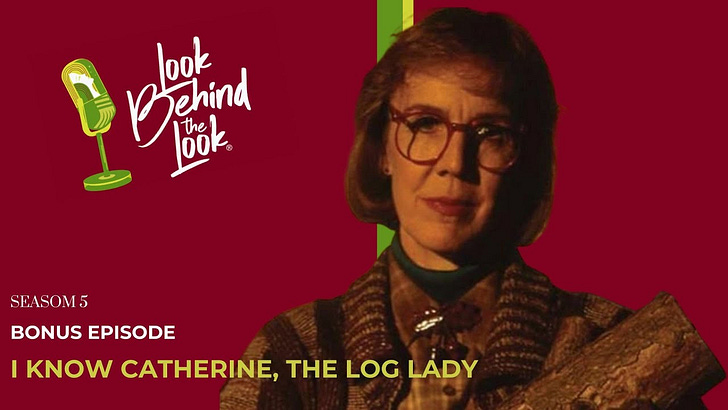
Look Behind The Log Lady


 YouTube YouTube
 Apple Podcasts Apple Podcasts
 Spotify Spotify
 Goodpods Goodpods
 Amazon Music Amazon Music
 iHeartRadio iHeartRadio
 Podchaser Podchaser
 Overcast Overcast
 PocketCasts PocketCasts
 Castro Castro
 Castbox Castbox
 TuneIn TuneIn
 Deezer Deezer
 Spreaker Spreaker
 RadioPublic RadioPublic
 Pandora Pandora
 Podcast Addict Podcast Addict
 Soundcloud Soundcloud
 RSS Feed RSS Feed
In this episode of Look Behind The Look, my better half, Jayce Bartok, guest hosts and delves into the life and legacy of Catherine Coulson, famously known as the Log Lady from David Lynch's Twin Peaks. Jayce shared with director Richard Green his experience watching the documentary I Know Catherine the Log Lady, which paints a vivid portrait of her multifaceted life as an actress, camera operator, and a vibrant personality who faced her illness with unwavering commitment to her craft.
Richard reveals the intricate journey of bringing Catherine's story to the screen. From the challenges of navigating intense NDAs to capturing Catherine’s essence beyond her iconic role, Richard discusses the profound impact Catherine had on those around her and the lessons he learned throughout the filmmaking process.
Jayce and Richard discuss the emotional weight of Catherine's final moments, her passion for performance, and the unique bond she shared with David Lynch as they worked together to create magic ...even in her last days. This episode is a celebration of resilience, artistry, and the indelible mark left by a beloved figure in television history.
Learn More About the Film HERE (and check out the shop for cute merch!)
Get full access to Look Behind The Look at lookbehindthelook.substack.com/subscribe
0:07 Welcome to Look Behind the Look, the celebrated podcast that explores your favorite looks in film, television and fashion history. Through conversations with the fashion world's elite and award-winning hair, makeup and costume designers on sets around the world, you will see and hear exciting tales from behind the scenes, career origin stories and tons of advice and tips. I'm your host, Tiffany Bartok. This is not Tiffany Bartok. This is Jace Bartok, her husband and partner in Look Behind the Look. Now, when I heard about I Know Catherine the Log Lady, a wonderful documentary about Catherine Coulson, the log lady from Twin Peaks, I was like, I need to do this interview. I know I never get to interview anyone.
0:49 I am not the host, but I must do this. tiffany happened to be on set so i had my opportunity i was so excited i watched the film i really enjoyed this heartfelt film about katherine colson who beyond the long lady was a consummate actor assistant camera operator to dps like frederick elms who was david lynch's main dp um just her whole life and the scope of it and i Her marriages and love affairs and theater career is just a fascinating portrait, not to mention, of course, the very dramatic end of her life where she was supposed to appear in season three of Twin Peaks, its comeback. She was very, very sick.
1:30 She was diagnosed with cancer and she didn't have long to live. But she somehow managed to get a message to David Lynch and get the film crew to come up and film her. And she passed away a few days later. And it's this incredible, heartfelt story about her commitment to her art. And in the end, that is sort of the stamp on her life is that she was able to sort of facilitate this appearance in season three by incredible circumstances. David Lynch directing her over Skype. But it's a beautiful film. Anyway, I was all set for my interview, was ready to go to talk to Richard Green. And our Internet literally was going in and out. So I get my big opportunity and I instantly freeze.
2:12 You know, you freeze and your face makes that horrible like, you know, and it was super awkward. I started sweating profusely. Tiffany was nowhere to be found, but we persisted. But long story short, here is Richard Green's beautiful interview about I Know Catherine, the Log Lady. I am not on camera because I was frozen, but you can hear me. And if you choose to see it on YouTube, you can see Richard. And it's really fascinating about how the whole film came about. The film is playing theaters all over the country right now. You can find a theater near you at iknowcatherine.com. Okay, I hope you enjoy this short but very interesting interview.
2:54 One of my dearest, closest friends is Catherine Colson, for sure. Hi, this is Catherine Colson. C-O-U-L-S-O-N. I'm on hospice. I probably don't have a whole lot longer. In 1990, Catherine Coulson became an international cult icon as the log lady in the groundbreaking television series Twin Peaks. 2014, the big news, Mark Fust and David Lynch were going to return. Catherine was hiding the fact that she was so sick. It was stage four. Hospice said, what's your heart's desire? She said she wanted to finish her work on Twin Peaks.
3:36 We were up to that point where she was supposed to be working and coming up to work. The producer was trying to organize a medical plane to bring her up. She was going to fly to Washington. It could have killed her. How could David put Catherine, who's dying, in a position as an actor portraying this woman? It's time. Who is dying. The show must go on. It's life. Life goes on. The story has to be told no matter what. Tell the story. I know Catherine, the log lady. We'll all see each other again.
4:18 We're here with Richard Green, director of the wonderful documentary, I Know Catherine the Log Lady. Richard, tell me how you came to Catherine in this incredible story. Obviously, huge Twin Peaks fan, huge Log Lady fan, was so taken with her journey and how she got there and everything that she did. And how did you come to this film? So when Catherine passed away, which is now 10 years ago in September, I got a call that afternoon from Donna Dubain. Timmy Near was up there and called Donna, who couldn't get up there, and told her that they had all signed a $6 million penultied NDA. So if you spoke about what was shot that day, you would owe CBS and CBS.
5:02 and david lynch's company six million million oh my god you're kidding me didn't want anybody to talk about well twin peaks hadn't even come out at that right and it was such a an inflammatory kind of story i mean it's just amazing what happened so i immediately she told me that they did this and katherine died four days after shooting this in her living room i'm like wow this is a this is a story right i thought it would get financed really quickly because twin peaks was coming out i'm not that connected to hollywood that i knew where to go and how to go and so eventually you um decided to finance it myself initially my first interview was with david and once i had that interview i just knew that there was a movie here i mean it was just so obvious to me that if i could just get the other interviews we could do it but something that david wanted and that i wanted too was catherine's life was so broad and so much bigger than twin peaks and in and of itself even though that's by far the most famous thing she did we didn't want it to be a twin peaks movie we wanted to be a catherine movie So I knew that that was really important to Dave and it was really important to me.
6:10 And that's how we approached it. I didn't even watch season three until I conducted 65 interviews on this film and had a real strong sense of Catherine's life. That's when I went back and I watched the third season of Twin Peaks and started, you know, cutting pieces and figuring out how to tell it. Richard, what an amazing story. So did you have to wait that stretch of time before the NDA, for the NDA to expire? No, no. David wanted this thing told. Okay. And so I called Annie Lundgren, who's in this movie. Right. And is a wonderful producer up in Ashland, Oregon. I called her through some people I knew, suggested that I talk to her.
6:53 And It became clear to me that there were two things that I could get done. One, if David would release everybody from the NDA, they would all talk to me, but they wouldn't talk to me without being released. I mean, six million dollars, a lot of money. And the other thing is nobody was supposed to shoot anything. But I found out somebody had videotaped the whole thing and there were still photographs and the audio recording was running the whole time. Right. So nobody wanted to admit that they had these photographs, but I kept hearing about it. People would say, I've got these photographs, but you can't. So I had to go back to David and say, look, they need to be released from the NDA or they won't talk. And he said, no problem. Let them say anything they want.
7:34 No restrictions. And I said, great. Gave me that in writing. And then I say, and there are these photographs. And he went, oh, my God, really? And I sent them the photographs and promised that I wouldn't use them in the in the campaign because they're they're hard to look at if you're not if they're out of context. Right. All the photographs, I was upset by them. Oh, my God, she looks horrible. And. You know, they weren't color time. So her hair and her head looks really white. And it's like, oh, my God. But once you see the photographs in the context of this joyous event and hear that dialogue that went down, it's a whole different picture. So we were able to include some of those. We include some of David talking to her off.
8:15 You know, every conversation Catherine did at the end of her life, somebody was recording. That blew my mind. And I love that you waited till the end of the film to show those pictures because you got to know this woman that was so dynamic and so beautiful and so interesting. And like as as an actor and a filmmaker, like, you know, I'm shooting this thing right now where I am a co-writer produced acting in an operating B camera. Right. And I'm learning that she was this like acclaimed actress. operator for for Frederick Elms right like being a very individual person you kind of you show us this beautiful life um which obviously the end of the film is so moving about how she her commitment to want to do this you know what I mean this kind of defining character and she wanted to kind of connect to that character before her time ran out it's it's very super moving you know it just occurs to me as you're speaking that and I really appreciate these questions they're thought they're thoughtful thank you that if you were a fabulous baseball player, but at the end of your life, you couldn't go pitch a game and win a game.
9:25 You're not going to be able to do it at 72 years old with cancer. But Catherine could play this role. that last time that last day and do it with you know excitement and vigor and insight it's you know it's a little for me it's chilling to realize that in some ways not only is she talking to hawk you know the her friend the depth you know the sheriff she's also talking to david oh see you again and like we talked about when we were face to face and And hearing about that process of David directing her and people sort of reporting, you know, your crew members and the filmmakers at the time being like, David was really hard on her.
10:10 Maybe he's a little too hard on her. And then realizing that that was their process. And of course, Catherine was looking for that full experience as a performer. And you show this dynamic performer and dynamic woman that she wanted to be directed. Yeah. You know what I mean? She wanted to do this. Everything that that involved. You know what I mean? And it was just a really beautiful portrait. I guess our show really focuses on the making of and the looks behind the looks. And you talk about this in the film. So forgive me for asking again. Can you talk about Catherine's connection to that iconic look? The iconic log lady look? and the origin of that character.
10:51 I know you speak about it in your film and it's really interesting, but if you could sort of encapsulate that. Sure. The character came about from a wacky idea. I think one of the nice moments of the movie that I love is when David talks about this. And he said, I had this idea. It was kind of stupid idea about this lady with a log. And we don't go too much into it. What the actual thing was, is she had a little boy, and she would take the boy and the log to the dentist and put the log in the dental chair and put the little bib around the log so that the boy could learn about things that the boy was going to be doing.
11:31 And David wanted to explore, it was a wacky idea, explore the world through this boy and this mother and this log, and that Catherine would be the lead. And years later when they're getting ready to shoot in twin peaks he gets this idea to put her in the back of the room just opening and closing the lights you don't you know she has no dialogue she says once in that pilot but it was iconic and um the development i mean i think it was catherine with the red glasses and i think the the clothing you know this is not how catherine colson dressed but it the log lady had her own style Really, seriously, I would be interested in talking to the costumer at that point to see how that evolved as well.
12:17 I'm interested, as you are, in our processes. I'll tell you something. You mentioned that your second camera on this piece that you're acting in and producing it co-wrote, right? This is the name of the game for Catherine. And what I was told recently... is that when, and this was Sabrina Sutherland, I think, was telling us this, that when David did season three of Twin Peaks, The Return, he wanted to go back to the eraser head style of shooting, which is an extremely small crew. Just the intimacy of somebody doing sound, somebody doing camera, somebody helping with camera, and the actors and the director. I mean, that's it. They all fed themselves. You know, it was not a big crew, not a big fancy thing, not a lot of marketing research on the script.
13:01 They would do it from their guts, from their heart, which is so much like theater. You know, it's it's what can you what do you got a barn? I got a horse. Let's do a Western. Right. Any takeaways about anything that you learned from Catherine that you didn't know? I mean, you guys were friends and peers and you, you know, came up together. But in the course of making this, is there something that you learned about Catherine that really surprised you? Oh, yeah. What I've learned is what's continuing to surprise me now is how changed I was by this process. You are what you eat and your brain is what you consume as well.
13:45 And I've read some great books and I've spent a lot of time with some really great people, David Lynch amongst them. This whole cast are super extraordinary accomplished people because if you're Catherine or you're David, you're going to attract really interesting people to you and you're going to select the people you want to hang out with from the most interesting. So here we have this distillation of, you know, we're talking about Pulitzer Prize winning playwrights. Lisa Loomer just opened Real Women Have Curves on Broadway as a playwright. Kyle McLaughlin is taking his career in all new levels now with Fallout and other things that he's doing. This is an incredibly...
14:27 incredibly eloquent but insightful group of people who were close to Catherine because Catherine wanted really insightful, interesting people around her. And to spend a few years, seven years, talking with them initially and then just listening to their words and the essential wisdom of Catherine's life just kept coming and hitting me. So it's changed me personally, dramatically. I've been doing TM now for seven years, inspired by the movie. And I think that my determination to stick with this until it was right is part of what I got from Catherine as well, that despite the toughness and the challenges, being in the moment and appreciating that moment, I can't tell you how many people told me Catherine just about conversations they would have around the streets of Ashland, the amount of care and attention, being present, there's nothing more important.
15:24 I'm not, I don't spend my time worrying too much about what's going to happen with this film. I'm too involved with the moment. And that's a blessing because we all have plenty of anxiety about what's happening in our world and where it's going in, in our own lives. So to remember that this is our life, be here now was her email address, right? And, you know, it's, so on that level, the relationships it brought, it has brought me in the collaborations that I've made with Jane Albishay, our executive producer, Alexandra Shurun, who's our art director and did all these beautiful illustrations. um and so many other people in the film it's changed me and that that surprised me i didn't i didn't expect to be have my life view and attitude change um and but it's a nice it's a nice way to live life i'm i'm i'm glad i'm enjoying this interview and here we are Richard, that was absolutely beautiful and means the world to me and our listeners, you know, for those making documentaries over years and years and trying to sort of like distill a life.
16:30 You did a beautiful job and it was just wonderful talking to you. Thank you very, very much. I look forward to seeing some of your work too. Look Behind the Look is a Vinyl Foot production written by me, your host, Tiffany Bartok. Produced by Jace Bartok, edited by Mugresh Takor. If you're interested in learning more, find our video version on the YouTube channel, Look Behind the Look podcast. There you can see rare photos and clips from our guests. And please follow us on Twitter at Look Behind Pod and Instagram at Look Behind the Look. If you like the show, please rate, review, and subscribe. And tell your friends and spread the word. You can subscribe to us on iTunes or any podcatcher of your choice. Thanks for listening to Look Behind the Look.


